Note on Funding & Collaborative Development
Because this long-term spectral–yield optimisation service requires multi-season data collection, model development, and iterative refinement, the most effective route to delivering it is through an Innovate UK project or similar collaborative funding scheme.
These programmes support innovation that combines advanced measurement, AI modelling, and real-world agricultural testing. Using such a framework reduces financial risk for growers, enables deeper technical development, and allows both parties to build a scalable, data-driven system for improving crop productivity and energy efficiency.
Collaborative Spectral Intelligence & Yield Optimization Programme
A long-term data partnership for scientifically guided greenhouse performance
Modern controlled-environment agriculture is shifting from intuition-based decisions to evidence-driven optimisation. While isolated spectral measurements provide valuable insight, the real transformative power emerges when light-quality data is continuously collected, correlated with crop performance, and used to refine lighting and environmental strategies over time.
This service establishes a long-term collaborative framework between BelgraLux and greenhouse operators to generate exactly that.
What This Programme Provides
1. Continuous Spectral Data Acquisition Across the Growth Cycle
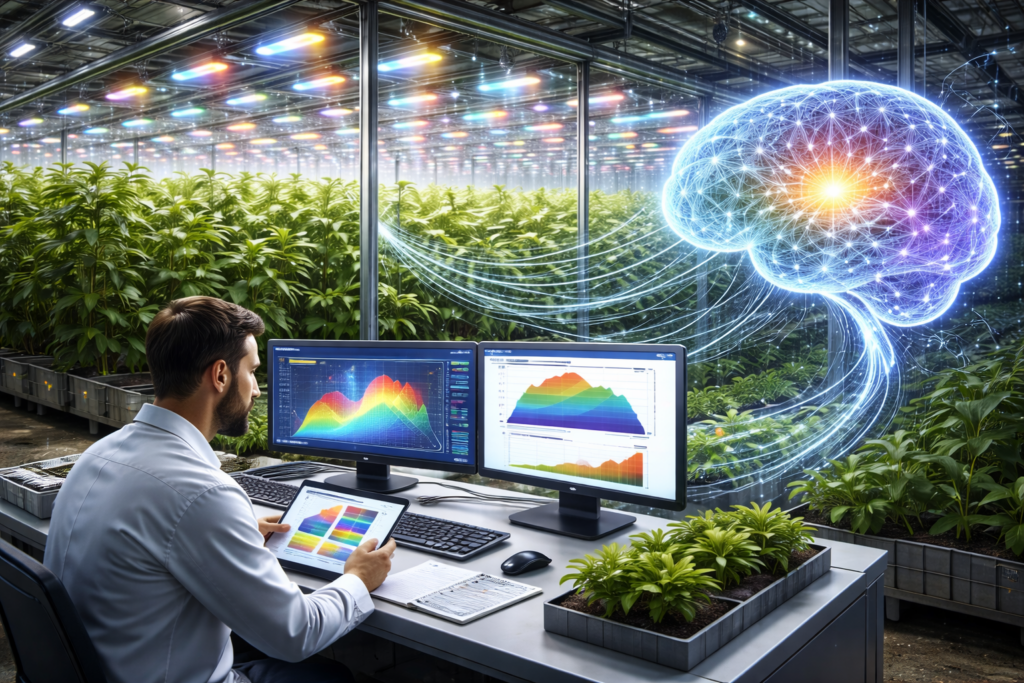
Instead of one-off measurements, we deploy high-resolution spectroradiometric mapping at regular intervals, capturing wavelength-resolved intensity distributions throughout the greenhouse.
This creates a temporal dataset, showing how lighting conditions evolve with seasonal changes, lamp ageing, fixture positioning, shading effects, canopy growth, and operational practices.
2. Crop-Specific Biomass & Yield Data Integration
Working collaboratively, growers provide structured yield and growth-stage metrics (e.g., biomass, fruit/flower count, stem elongation, colouration parameters, or productivity indices).
BelgraLux integrates these agronomic outputs with matched spectral datasets, enabling cause–effect modelling of how different spectral signatures influence plant performance.
3. Multi-Month or Multi-Season Modelling
By analysing light conditions and crop outcomes over several cycles, subtle interactions become visible:
- Effects of blue:red ratios on morphology and compactness
- Influence of far-red on flowering behaviour or shade-avoidance responses
- Photoreceptor-specific responses (e.g., phytochrome balance, cryptochrome activation)
- Efficiency losses due to spectral drift from ageing luminaires
These relationships cannot be reliably identified through one-time measurements—they require time-series datasets, which this collaboration provides.
4. Machine-Learning Models for Predictive Optimisation
Accumulated spectral-yield records form the training data for AI-based models capable of:
- Predicting expected yield under a given spectral profile
- Identifying limiting wavelengths or under-represented bands
- Simulating “ideal spectral environments” for a specific crop
- Detecting inefficiencies caused by fixture placement or canopy development
This gives growers an objective, scientifically derived guide for future lighting strategies, not just a snapshot of current performance.
5. Joint Development of Crop-Specific Spectral Targets
The combined dataset allows BelgraLux and the grower to co-create custom spectral targets tailored to each cultivar, growth stage, and production goal.
Instead of relying on generic LED recommendations, the greenhouse benefits from a site-specific, evidence-calibrated spectral plan.
6. Continuous Feedback & Optimisation Cycles
Every measurement cycle feeds back into the model:
- Measure spectral distribution
- Collect yield/growth data
- Analyse correlations
- Adjust spectral targets or fixture configuration
- Repeat
- Gradually converge toward maximal efficiency and quality
This iterative improvement loop is impossible without structured long-term collaboration.
Why This Programme Matters
Most growers know light is important. Few know precisely which wavelengths matter, how much, and for which growth phases. Even fewer have quantitative evidence linking light spectra to their own crop performance.
This programme provides:
- Data-driven optimisation
- Reduction in wasted energy
- Increased yield consistency
- Improved morphology and quality
- Roadmap toward full spectral intelligence and automation
It transforms lighting from an operational cost into a predictive, optimised, measurable process.