
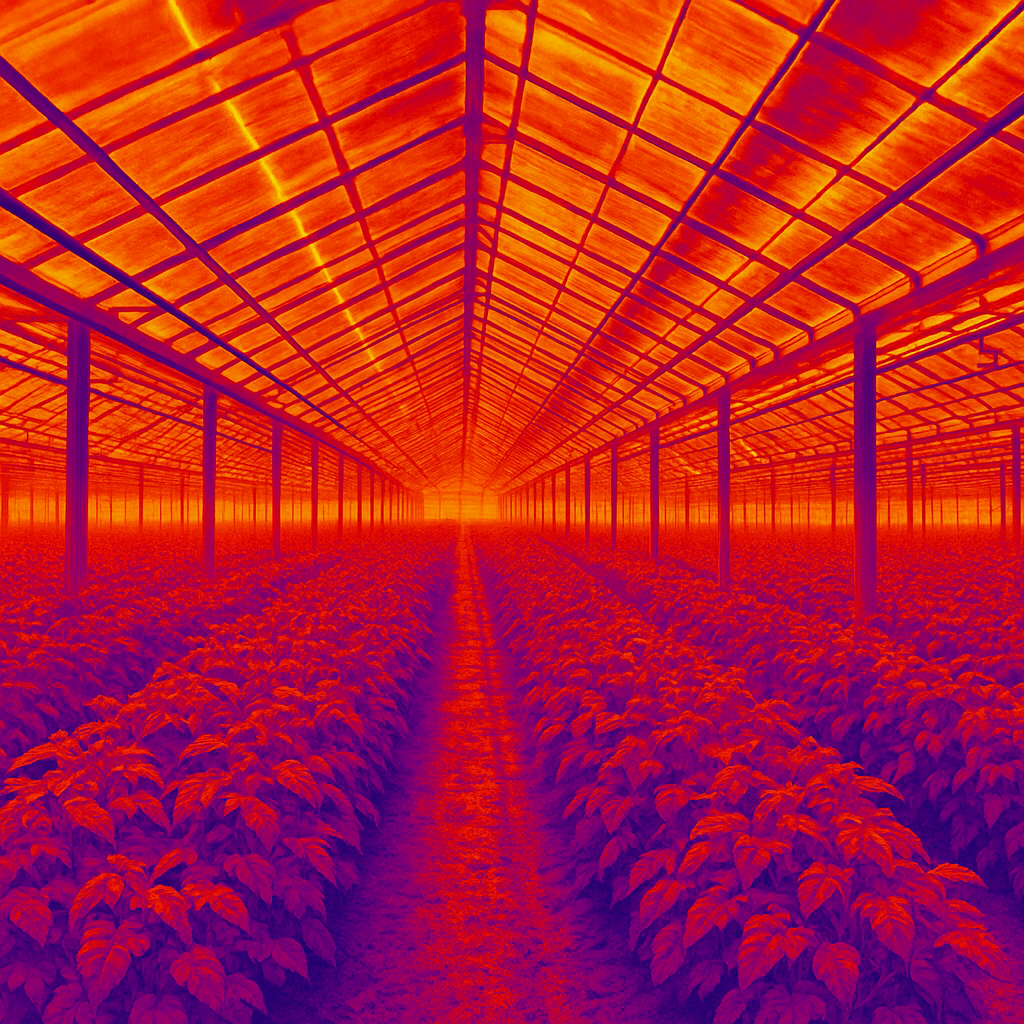
Thermal imaging provides a complementary layer of analysis by revealing how heat moves through the greenhouse structure and growing environment. High-resolution thermal cameras can identify areas of heat loss, such as poorly insulated walls, damaged glazing, gaps in sealing, or underperforming heating elements. They also detect cold air ingress, drafts, and temperature gradients created by vents, doors, or external weather conditions. Within the greenhouse, thermal mapping highlights variations in canopy temperature linked to transpiration rates, plant stress, irrigation patterns, and local microclimates. By converting these measurements into spatial thermal maps, it becomes possible to pinpoint inefficiencies, optimise energy use, improve environmental uniformity, and ensure crops grow under stable, controlled thermal conditions that support consistent physiological performance.
Integrating Thermal and Spectral Analysis for Optimised and Sustainable Production
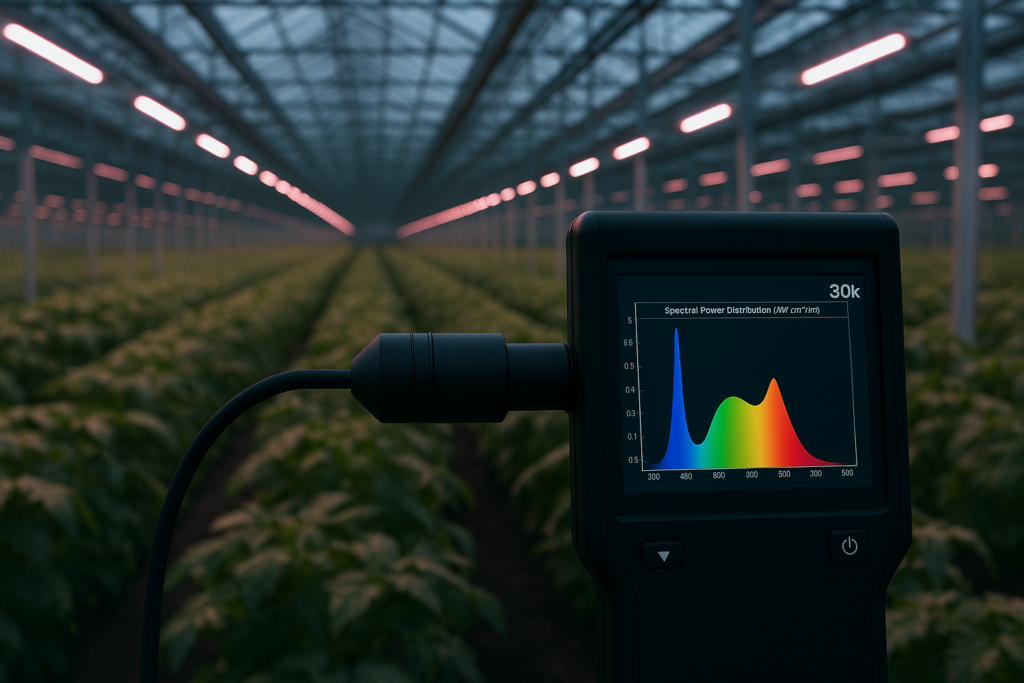
When thermal mapping is combined with wavelength-resolved spectral analysis, the greenhouse can be evaluated as a complete energy–light system. Thermal imaging identifies heat loss, inefficient insulation, cold infiltration, and uneven temperature zones, while spectral measurements reveal how light quality and intensity vary across the same spatial regions. Together, these datasets make it possible to optimise both energy use and crop performance simultaneously. Areas that require excessive heating or lighting can be identified and corrected, reducing operational costs and eliminating wasted energy. By ensuring that plants receive the correct spectral composition at stable temperatures, growers can achieve more uniform growth, higher yields, and improved resource efficiency. This integrated approach supports greener production by lowering energy consumption, reducing carbon footprint, and aligning environmental control with the precise physiological needs of each crop.