
Our Measurement Technology
At BelgraLux we don’t guess about light – we measure every nanometre of it.
Our service is built around research-grade spectroradiometry: instruments that record the full spectral power distribution (SPD) of your greenhouse lighting rather than just “how bright” it is. That allows us to describe exactly how many photons of each wavelength your plants actually receive, and how that varies across space and time.
We combine two complementary systems:
- a field spectroradiometer (JETI specbos-class), optimised for in-situ measurements in the greenhouse;
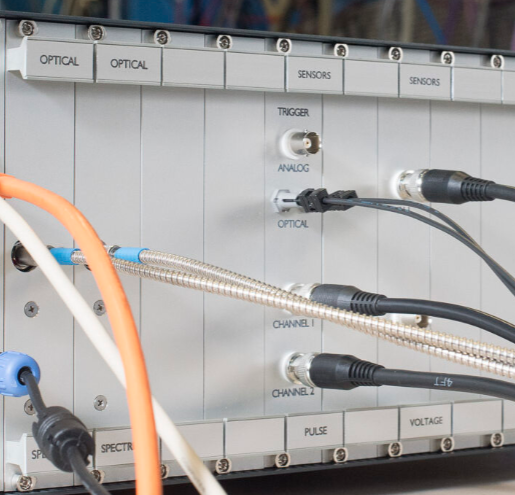
- a multi-channel laboratory spectrometer platform (PLASUS EMICON MC-class) for ultra-high-resolution characterisation and long-term monitoring of light sources.
Together they give us a complete, traceable description of your lighting environment.
1. Field Spectroradiometry in the Greenhouse
Our handheld spectroradiometer measures the spectrum from roughly the UV-A through the visible and into the near-IR (typical range ~350–1,000 nm, depending on configuration). It uses a fibre-coupled array spectrometer with factory radiometric calibration against traceable standards, so each pixel in the detector corresponds to a well-defined wavelength and absolute radiant power.
From a single measurement at each point we can calculate:
- Spectral Power Distribution (SPD) – the detailed shape of the spectrum in W·m⁻²·nm⁻¹.
- Photon-based metrics such as PPFD and YPFD (µmol·m⁻²·s⁻¹), integrated over any waveband (e.g. 400–700 nm for PAR, 380–780 nm for human vision, 660/730 nm for phytochrome).
- Spectral ratios (red:blue, red:far-red, green fraction, blue UV-A components) directly relevant to photomorphogenesis.
- Photometric and colourimetric quantities (lux, CCT, CRI, CIE x,y) when needed for human work-space evaluation.
Because the instrument measures the full spectrum and not just a broadband sensor response, we can re-analyse the same data later if new plant-response curves or regulations appear.
2. High-Resolution Source Characterisation
For deeper analysis of luminaires, LEDs and specialised light sources, we use a multi-channel spectrometer platform derived from the PLASUS EMICON MC system. This technology was originally developed for real-time plasma and emission monitoring in thin-film and coating processes, where both spectral resolution and stability are critical. Plasus
Key features relevant to horticultural lighting:
- Multiple spectrometer channels (up to eight) covering roughly 200–1,100 nm, allowing simultaneous measurement of UV, visible and near-IR bands.
- High spectral resolution on the order of 1–2 nm (model-dependent), which resolves narrow LED peaks and far-red shoulders that low-resolution devices smear out.
- Fibre-optic coupling so we can monitor several fixtures or positions at once, or observe the spectrum inside optical systems and growth chambers.
- Continuous operation with robust monitoring electronics, originally designed for industrial vacuum systems, giving excellent long-term stability. Plasus
We use this platform to:
- verify manufacturer datasheets and binning claims,
- quantify spectral changes with dimming, duty-cycle or ageing,
- build reference spectral libraries for your luminaires that are later used in our greenhouse-mapping analysis.
3. From Point Measurements to Spectral Maps
In the greenhouse we measure SPDs on a 2D grid (e.g. every 0.5–1.0 m) at canopy height. For each grid point we record:
- the full spectrum (typically 350–1,000 nm),
- PPFD and other photon metrics,
- red/blue and red/far-red ratios,
- correlated colour temperature and any required regulatory metrics.
These data are then interpolated into 2D and 3D spectral maps:
- 2D heatmaps show, for each wavelength band, how intensity varies across the growing area (e.g. blue 430–470 nm, red 620–670 nm, far-red 700–750 nm).
- 3D surfaces visualise spatial gradients, so you can see under-lit corners, hotspots, or areas with skewed red:blue balance that might drive uneven morphology.
Because all maps come from wavelength-resolved measurements, you can switch between metrics without re-measuring: the same dataset can be re-plotted as PPFD, YPFD, red:far-red ratio, or phytochrome photoequilibrium for a given crop model.
4. Why This Is Different From Typical Greenhouse Light Measurements
Most commercial greenhouse audits still rely on:
- lux meters (human-vision weighted, largely blind to red/far-red),
- simple PAR sensors (integrated 400–700 nm with fixed spectral weighting), or
- single-point measurements taken at a handful of positions.
Those tools cannot:
- distinguish whether “100 µmol·m⁻²·s⁻¹” is mostly blue, green, red, or far-red,
- detect spectral gaps where chlorophyll or carotenoids absorb poorly,
- quantify the exact red/far-red balance that drives phytochrome-mediated responses,
- or reveal spatial patterns in spectrum as well as intensity.
Our spectroradiometric approach is spectrally resolved, spatially resolved, and traceable:
- Spectrally resolved – we keep the full SPD at 1–2 nm steps.
- Spatially resolved – we build maps rather than a few spot readings.
- Traceable – both instrument families are calibrated against national standards and include correction for detector non-linearity and stray light, as specified by the manufacturers.
This combination lets us link your lighting directly to known plant action spectra (chlorophyll, carotenoids, phytochrome, cryptochromes) and to emerging horticultural standards, rather than relying on generic “lux” or “PAR” numbers.
5. Data Integrity and Reporting
Every BelgraLux report includes:
- measurement geometry (height, angle, field of view),
- instrument settings and calibration status,
- estimated measurement uncertainty,
- raw spectral plots for representative positions,
- spatial maps for key wavebands and ratios,
- and clear, plant-focused recommendations.
In short, our technology stack takes the same level of spectral detail used in laboratory photobiology and industrial plasma diagnostics and brings it into day-to-day greenhouse decision-making.